Why SAMMRI matters — and why I've proudly backed it for nearly a decade
Nearly a decade ago, in 2016, I joined the board of an organisation that I believe represents one of the most important — and least celebrated — investments in South Africa's future. That organisation is SAMMRI: the South African Minerals to Metals Research Institute. And every year since, my conviction in what it does has only grown stronger.
South Africa sits on some of the most extraordinary mineral wealth on the planet. But mineral wealth in the ground is only potential. To turn that potential into lasting prosperity — into jobs, into innovation, into a globally competitive industry — you need people. You need world-class engineers, researchers, and metallurgists who understand the unique complexities of South African ores. SAMMRI exists to develop exactly those people.
Maintaining and expanding South Africa's research and development capability is not a luxury — it is essential for the long-term survival and competitiveness of the industry. Without a thriving pipeline of postgraduate engineers and academics, our ability to respond to the technical challenges facing mining will simply erode, one retirement and one unfilled vacancy at a time.
What is SAMMRI?
SAMMRI is a non-profit company (NPC) that funds postgraduate research at South African universities, supporting Masters and Doctoral students who are tackling the industry's hardest problems in minerals processing, metallurgy, and related engineering disciplines.
The model is elegantly simple and powerfully effective: member companies pool funding, SAMMRI identifies research priorities aligned with industry needs, and universities deploy their academic talent and infrastructure. The result is research that is genuinely relevant — not academic for its own sake — while simultaneously training the next generation of engineers and the academics who will teach them.
One of SAMMRI's founding objectives was to shift the centre of gravity of South African minerals research back home. For too long, work that was directly relevant to South African ores, operations, and conditions was being done at overseas institutions — at greater cost to industry, and with less direct benefit to local universities and students. SAMMRI was designed to change that: to build local capability, anchor it in South African institutions, and facilitate productive collaboration between those institutions and their international counterparts — rather than ceding the research to them.
Since its founding, SAMMRI has supported research at ten South African universities — spanning the country geographically and institutionally, from the University of Cape Town and Stellenbosch University to the University of Limpopo, the University of KwaZulu-Natal, the University of Pretoria, Nelson Mandela University, and the North-West University. This breadth reflects a deliberate commitment to building capacity across the full landscape of South African higher education, not just at a handful of institutions.
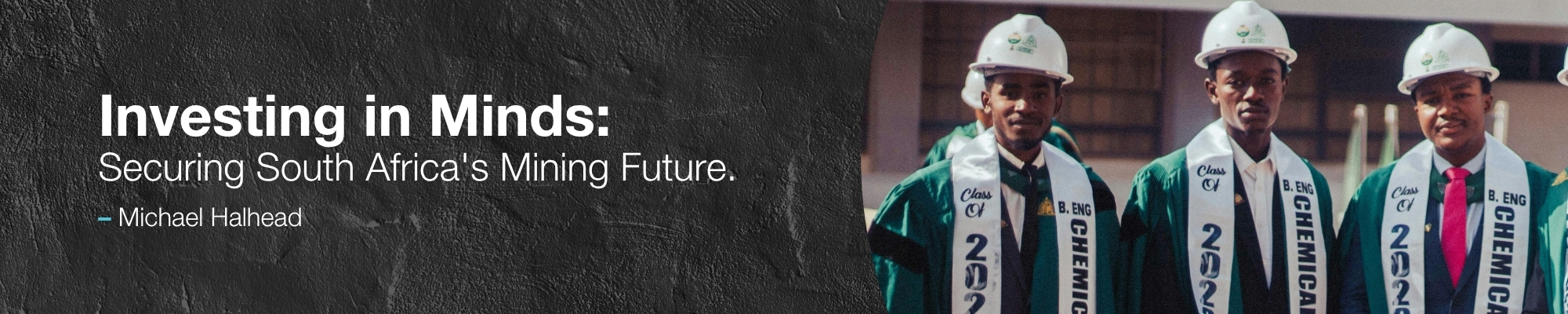
Perhaps the most telling measure of SAMMRI's impact is this: 91 postgraduate students have been sponsored. Of those who have completed their studies, 39 have earned Masters degrees and 25 have earned PhDs — 64 graduates in total, with a further 18 currently in progress. Only 9 students did not complete. That is an 88% completion rate among those who have finished, which is exceptional for postgraduate research anywhere in the world, let alone in the context of a resource-constrained industry programme.
Equally important: roughly 45% of SAMMRI-sponsored students are historically disadvantaged South Africans. This was not accidental. SAMMRI made a conscious effort to drive transformation — to ensure that the next generation of minerals engineers looks like the country it serves. Each graduate represents not just a qualification, but proof that world-class research and genuine transformation are not in tension — they are entirely compatible.
What Has SAMMRI Achieved?
The track record speaks for itself. Over more than a decade, SAMMRI-funded researchers have worked on some of the most pressing technical challenges facing the industry — from flotation chemistry and reagent fundamentals, to advanced comminution, process simulation, digital twins, and water efficiency under South Africa's increasingly constrained water environment.
Recent projects illustrate just how sophisticated and impactful this research has become. One current SAMMRI-funded student is developing a transparent, modular, open-source simulation platform that integrates crushing, milling, and flotation circuits into a unified dynamic model — the kind of tool that previously only existed as expensive proprietary software, now being built by a South African postgraduate for the benefit of the whole industry. Another is advancing fundamental understanding of frother chemistry under varying water quality conditions, directly relevant to the real-world challenge of process water reuse.
SAMMRI is also developing a Technology Roadmap for 2026–2031, identifying three strategic research priorities: optimising resource utilisation from complex and low-grade ores; improving metallurgical efficiency through digital tools and process innovation; and advancing environmental stewardship through water recycling, energy reduction, and waste valorisation. When published, this roadmap will position SAMMRI not just as a funding vehicle, but as a strategic intelligence hub for the industry.
Why It Matters for South Africa and the Mining Industry
Mining and minerals processing contribute roughly 6.5% of South Africa's GDP — a figure that, given the extraordinary mineral endowment of this country, is far smaller than it should be. The sector employs hundreds of thousands of people directly, with multiplier effects that reach far deeper into the economy. Unlocking more of that potential requires the industry to continuously innovate its way through compounding pressures: electricity tariffs that have risen sharply above inflation year after year, declining ore grades requiring ever-more-sophisticated processing, increasing water scarcity, and a global race to secure critical minerals for the energy transition.
SAMMRI is, to my knowledge, the only industry-led organisation that seeks to develop higher-level technical skills across the entire minerals processing chain — from concentrators through smelters to refineries. Most other initiatives are narrower in scope, focused on a single commodity or processing stage. SAMMRI's span is unique, and it is precisely what makes it so strategically valuable to an industry that must navigate the full value chain.
Meeting these challenges requires continuous innovation. And innovation requires people. South Africa cannot import its way out of this challenge — it must develop its own engineers, trained on its own ores, in its own institutions, solving its own problems. If the pipeline of postgraduate engineering talent dries up, it will take a generation to rebuild it. Maintaining and expanding that R&D capability is not optional — it is a prerequisite for the industry's long-term survival.
The consequences of losing this capability are concrete and uncomfortable. If South Africa cannot do this research locally, it will have to be done overseas. That means higher costs for industry, longer timelines, and research conducted by teams without intimate knowledge of South African ore bodies, water conditions, regulatory realities, and operational constraints. It also means South Africa loses its seat at the table — its ability to shape the research agenda, influence the direction of technology development, and build the institutional relationships that create lasting competitive advantage. Local capability is not just cheaper. It is more agile, more relevant, and more strategically valuable.
SAMMRI also creates something that money cannot easily buy: a community of practice. Academics, students, and industry professionals who work together, who understand each other's constraints, and who build the relationships that make genuine collaboration possible. In a sector sometimes characterised by siloed thinking, that community is genuinely precious.
The Road Ahead
SAMMRI is evolving. A new operational model is taking shape — moving from year-to-year project funding to multi-year research initiatives, structured around cross-commodity themes with broader industry relevance. The organisation is pursuing THRIP co-funding, which would see every industry rand matched by government funding, effectively doubling the research output for the same contribution. The ambition is to grow to eight active projects per annum, engaging a wider community of mining companies, technology providers, and engineering consultancies.
As someone who has been part of this journey since 2016, I am genuinely excited about where SAMMRI is headed. The work is hard — sustaining an organisation like this requires constant advocacy, constant fundraising, and constant belief in something whose returns are measured in years and decades, not quarters. But those returns are real, and they are profoundly important for South Africa.
If you are a mining company, technology provider, or engineering consultancy operating in South Africa — or if you simply believe that investing in the next generation of engineers is one of the highest-return decisions our industry can make — I encourage you to explore SAMMRI. The cost of joining is modest. The cost of not building this capacity is not.
If you would like to learn more or explore how your organisation can get involved, please reach out to me directly. Let's build South Africa's minerals future together.